

Introduction
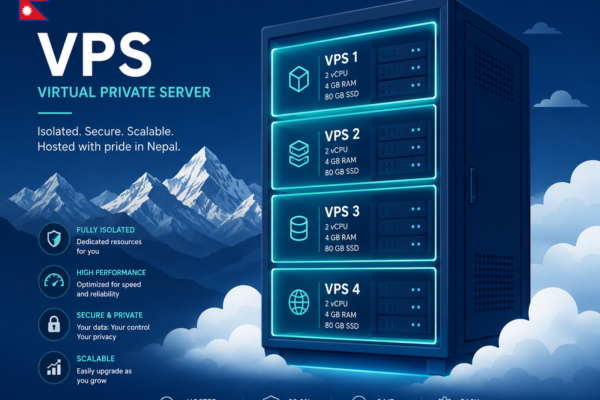
The rise of autonomous AI agents is reshaping how tasks are planned, executed, and monitored. These systems can make decisions, carry out multi-step workflows, and interact with tools and APIs with limited human input. As a result, the underlying infrastructure must sustain continuous operation, reliability, and rapid responsiveness. This dynamic has driven a measurable increase in demand for virtual private server solutions that offer control, isolation, and predictable performance.
For Nepali developers, startup founders, and IT professionals, VPS presents a practical balance of locality, cost efficiency, and scalability to support AI agent workloads. Teams deploying chat-enabled agents or data processing bots often experience sustained CPU utilization during peak periods, underscoring the need for predictable performance guarantees rather than bursty cloud credits.
Local optimization, performance, security, and migration considerations
This section outlines four core areas essential to leveraging VPS in the AI agentic era. First, local optimization focuses on routing, data locality, and regional performance to minimize latency for agent-driven tasks. Practical steps include selecting a VPS with a data center near the target user base, enabling CDN integration for static assets, and configuring DNS with low TTL values to reduce lookup times. For example, a Nepali fintech startup serving nearby markets can colocate databases and agent gateways to shave milliseconds from response times, improving user experience during automated financial operations.
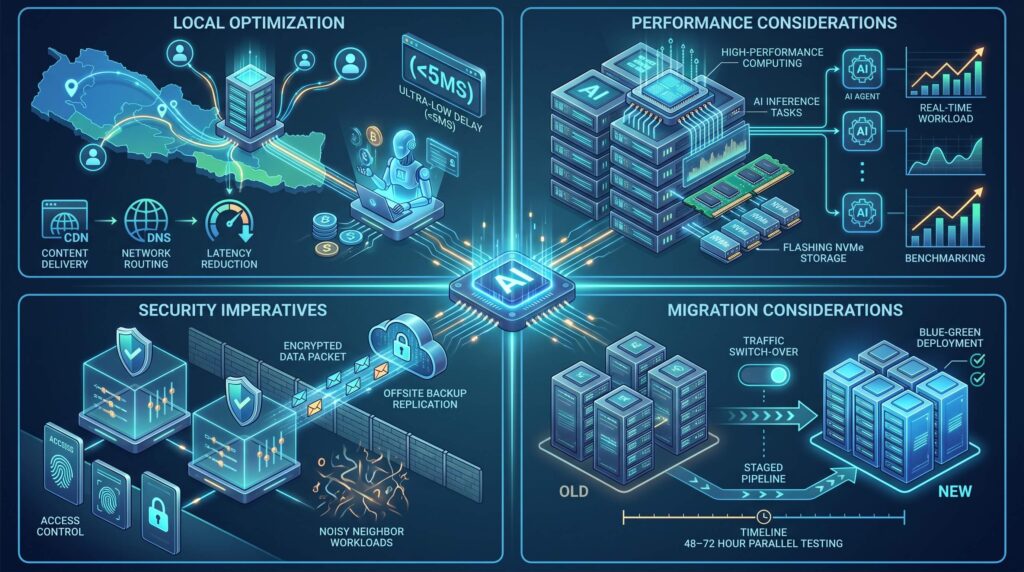
Second, performance considerations address CPU, memory, and storage throughput necessary for reliable automation. Actionable measures include reserving core pinning for critical agents, implementing swap policies with carving limits, and benchmarking with workloads that mirror agent decision loops. A mid-sized AI workflow may require a 4-core VPS with 8 or 16 GB RAM and NVMe storage to sustain concurrent agents processing API calls and local model inferences without queuing delays.
Third, security imperatives cover isolation, backups, and data sovereignty to protect automated workflows and sensitive data. Practical practices include enforcing container isolation, configuring automated daily backups with offsite replication, and implementing access controls aligned to local compliance standards. A real-world caveat is that shared virtualization can introduce noisy neighbor risks; dedicated or sandboxed environments are preferred when handling regulated data or critical decision logs.
Finally, migration considerations examine seamless onboarding from other providers, zero-downtime transitions, and practical templates to accelerate deployment. Steps consist of inventorying dependencies, exporting configuration backups, and validating the environment with staged rollouts. A recommended approach is to deploy a blue-green migration pattern: duplicate the agent cluster on a new VPS, run parallel tests for 48 or 72 hours, and switch traffic only after verification, ensuring continuity for mission-critical automation while minimizing risk.
1. Predictable Growth Drivers for VPS in an Agentic AI Era
AI-powered workloads and virtualization needs
As autonomous AI agents handle decision-making and workflow execution, there is a clear shift toward stable, isolated environments. VPS offers predictable resource allocation, reducing contention and ensuring consistent performance for long-running agent loops and monitoring activities.
For Nepali developers and small teams, VPS strikes a balance between control and cost, simplifying infrastructure management while delivering reliable performance guarantees essential for agent orchestration.
Edge and local data processing demands
Agent-based systems increasingly perform processing near data sources to cut latency and safeguard sensitive information. Regional VPS deployments support local data routing and edge processing, shortening round trips to APIs and databases and accelerating real-time automation tasks.
Local hosting also aligns with data sovereignty considerations, helping maintain compliance while sustaining operational efficiency for Nepal-focused workloads.
Decoupling compute and storage for scalable agents
Scalable agent architectures benefit from separating compute resources from fast, persistent storage. VPS plans that offer independent CPU/memory and storage tiers enable rapid adaptation to changing workloads without overprovisioning.
NVMe-backed storage within VPS environments provides high I/O throughput, supporting data-intensive operations such as real-time ingestion, caching, and iterative model workups that many agent pipelines require.
2. Performance Must-Haves for VPS Providers
NVMe SSDs and I/O throughput
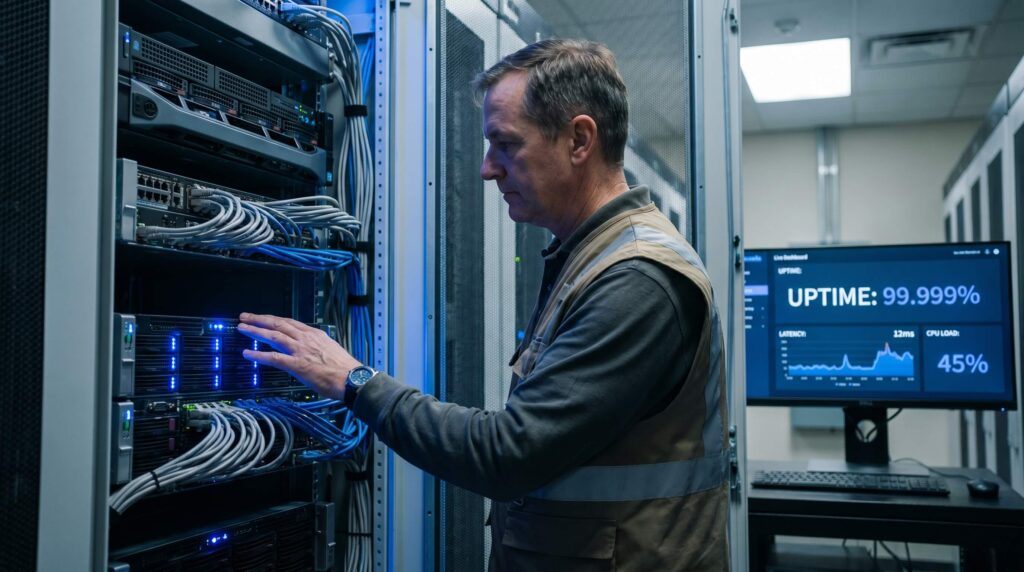
High-speed storage remains essential for AI agent workloads that frequently read and write large datasets. NVMe SSDs offer lower latency and higher I/O operations per second, enabling faster data ingestion, caching, and real-time decision-making. For agent pipelines that rely on rapid access to configuration, models, and results, storage performance directly influences overall throughput.
Real-world deployments indicate that NVMe arrays can reduce restore times during iterative tuning and model checkpointing. Examples include image processing pipelines that stream intermediate tensors to a fast cache and systems that prefetch user profiles into memory to accelerate personalization at query time.
Providers should align storage tiering with workload profiles, offering burstable I/O for peak task periods while preserving cost efficiency during idle times. A two-tier model with a hot NVMe cache for active tasks and a larger, slower tier for archival data helps preserve response times during bursts such as period-end batch tasks or sudden workload surges.
CPU and memory tuning for agent workloads
Agent-centric tasks span from lightweight orchestration to intensive model interactions. Allocating appropriate CPU cores and memory ensures reliable loop execution and prevents bottlenecks in decision and action phases. Memory tuning should account for large payloads, in-memory caches, and concurrent agent processes.
Practically, teams should profile peak task windows and adjust CPU affinities to isolate latency-sensitive components, such as action executors, from orchestration. Memory governor settings can help avoid swapping and maintain steady throughput, particularly for multi-agent workloads running on edge or small on-premises deployments.
Network reliability and low latency for agent orchestration
Agent orchestration involves frequent API calls, remote tool interactions, and real-time status updates. A robust network path with low jitter ensures timely tool access, reduces timeouts, and improves coordination across agents. Redundant network interfaces and automated failover contribute to sustained availability.
Practical steps include multi-homed connections with automatic failover, monitoring RTT to critical endpoints, and regular chaos testing to validate failover behavior. Leveraging regional peering and backbone paths can yield meaningful latency improvements for common endpoints in the agent ecosystem.
| Performance Area | Key Considerations | Impact on AI Agents |
| NVMe SSDs and I/O | High IOPS, low latency, storage tiering | Faster data access, smoother throughput for real-time tasks |
| CPU and memory tuning | Core allocation, memory management, caching strategies | Predictable execution loops, reduced bottlenecks |
| Network reliability | Redundancy, low latency paths, stable uptime | Consistent communications with APIs and tools |
3. Security Imperatives in an Agentic AI World
Isolated containers and secure multi-tenant environments
Agentic AI workflows span multiple components and services, which can increase the risk of cross-workload interference. Isolated containers establish boundaries that prevent one agent from affecting another, reducing potential data leakage or dependency conflicts. Secure multi-tenant environments introduce controls for resource and access isolation, ensuring each agent operates within a clearly defined space.
Practically, this requires container runtimes that enforce strict namespace separation, process isolation, and precise permission models. Regular security auditing and adherence to least privilege principles help maintain a robust baseline as agent ecosystems scale within a VPS.
Automated backups and disaster recovery for AI tasks
AI pipelines depend on consistent data availability and rapid recovery capabilities. Automated backups scheduled at regular intervals protect model states, configurations, and datasets from corruption or loss. Restore verification procedures ensure recovery processes remain dependable under real-world conditions.
Disaster recovery planning should include offsite replication, tested failover procedures, and clear recovery objectives. For agent workloads, this translates to preserving the integrity of decision-making logic and ensuring continuity during hardware or software failures.
Compliance and data sovereignty considerations for Nepal-based workloads
Nepal-based workloads face regulatory and governance considerations related to data localization, access controls, and auditability. Hosting environments should support data sovereignty by keeping data within regional boundaries and providing transparent logging, access trails, and encryption at rest and in transit.
Organizations often require controls aligned with local policies and industry standards. Selecting a provider with regional data centers and documented compliance practices helps align AI agent deployments with statutory requirements while maintaining operational efficiency.
| Security Area | Practice Recommendation | Benefit for AI agents |
| Isolated containers | Strict namespace separation, least privilege | Reduced risk of cross-agent interference |
| Automated backups | Scheduled, verifiable restores | Quick recovery and data integrity |
| Data sovereignty | Regional data centers, compliant logging | Regulatory alignment and user trust |
4. Free Migration and Seamless Onboarding as Growth Levers
Migration paths from other providers
Organizations transitioning to VPS hosting for AI agents benefit from clearly defined migration options that reduce setup friction. Providers offering complimentary migration assistance can shorten the initial configuration phase by delivering an assessment of current workloads, dependency inventories, and network mapping to the new environment.
Typical migration paths encompass lift and shift of existing containers, recreation of agent environments in the target VPS, and a controlled cutover to minimize operational disruption.
Zero-downtime migration strategies
Zero-downtime migration is achievable through staged transfers and synchronized data replication. Approaches include live environment cloning and phased cutovers where traffic is gradually redirected to the new platform, preserving continuity for customer-facing applications and internal automation pipelines.
Automated health checks and rollback capabilities are essential to validate each migration step. Ongoing monitoring during the transition helps identify bottlenecks and maintain stability in agent workflows.
Initial configuration templates for agentic workloads
Pre-built templates provide a practical starting point for deploying AI agents on new VPS instances. Templates typically include secure user provisioning, baseline container runtimes, and common agent frameworks configured for observable loops. They enable rapid provisioning with minimal manual tuning.
Templates should accommodate local requirements such as regional language settings, logging standards, and compliance controls. By offering templates, providers help teams validate workflows quickly and focus on optimization rather than repetitive setup tasks.
| Migration Aspect | Benefit | Impact on AI Agents |
| Free migration assistance | Faster transition, reduced risk | Quicker access to VPS for agent workloads |
| Zero-downtime strategies | Continuous service during migration | Stability of automation pipelines |
| Initial templates | Rapid provisioning, consistent configurations | Fewer setup errors, faster agent deployment |
5. Local Optimization: Nepal-focused Infrastructure Strategies
Local optimization aligns infrastructure with Nepali business needs and regional user bases. Placing data closer to end users and ensuring regional resilience can deliver consistent performance for AI agent workloads and automated processes. Practical strategies cover latency reduction, cooling and power reliability, and pricing approaches suited to the local market.
Latency-aware data routing and POP placement
Strategic placement of points of presence and intelligent data routing reduces round-trip times for API calls and messaging between agents and external services. Regional POPs to minimize network hops for common Nepali endpoints. Dynamic routing that prioritizes low-latency paths during peak periods. Edge caching of static assets to relieve origin servers
These measures enhance the responsiveness of AI agents in customer support, data processing, and automation workflows that rely on timely data access.
Cooling, power resilience, and uptime in regional data centers
Regional data centers must balance reliability with operating costs. Redundant power feeds and uninterruptible power supplies to sustain 24/7 agent operations. Advanced cooling solutions appropriate to local climate conditions to maintain hardware longevity. Proactive monitoring and on-site engineering support to minimize maintenance windows. Reliability translates into lower disruption risk for autonomous processes and smoother scaling as AI workloads grow within Nepal.
Pricing models aligned with local market conditions
Pricing strategies should reflect local purchasing power and competitive dynamics while preserving service quality. Tiered plans that align with common workload bands for AI agents. Predictable monthly costs with transparent overage policies. Regional promotions tied to capacity expansion and longer-term commitments. Aligning pricing with the market supports broader adoption of VPS hosting for AI automation among Nepali startups and small businesses.
6. Backup, Recovery, and Reliability for Agentic Tasks
Reliability for autonomous AI workflows hinges on robust backup and recovery practices. Ensuring that agentic tasks can resume quickly after disruptions reduces potential downtime and preserves workflow integrity. This section outlines practical approaches to automatic backups, rapid recovery, and target resilience metrics tailored for agentic environments.
Automatic backups and restore verification
Automated backups should address both data and configuration states. Implement schedules that capture essential artifacts such as agent state, tool configurations, and signed model snapshots. Regular restore tests confirm that recovery pipelines function as intended and that restored environments reach an operational state without manual intervention. Incremental backups reduce storage needs while maintaining recoverability.
Verification runs validate the integrity and completeness of restored data. Offsite replication protects against regional outages and disaster scenarios. In practice, teams should maintain a clear restore playbook detailing step-by-step actions, expected recovery times, and rollback options if a restore reveals issues. This discipline supports continuous agent operations and minimizes service interruptions during restoration efforts.
Snapshot strategies for rapid recovery
Snapshots provide fast restoration points for both disk images and containerized environments. Implement snapshot cadences aligned with deployment cycles and critical automation milestones. Real-world practice includes coordinating snapshots with CI/CD events to capture consistent states during feature toggles. Periodic VM and container snapshots enable quick rollback to known-good states.
Testing snapshots in a staging environment verifies compatibility with ongoing agent updates. Automated snapshot lifecycle policies prevent outdated images from consuming resources. Effective snapshot strategy reduces mean time to recover (MTTR) and supports experimentation with new agent configurations without risking core workflows. Consider tagging snapshots with policy metadata to simplify retrieval during incidents.
RPO/RTO targets for autonomous agents
Define recovery objectives that reflect the criticality of agent tasks. Establish concrete targets for data loss tolerance (RPO) and downtime tolerance (RTO) to guide backup frequency and failover planning. Translate targets into automated policies where feasible, such as scheduled backups every 15 minutes for high-priority pipelines. RPO considerations weigh the importance of preserving recent task data versus system simplicity.
RTO planning determines acceptable restoration durations for automated pipelines. Regular reviews align targets with evolving agent workloads and business priorities. For Nepali organizations, aligning RPO and RTO with regional service expectations supports dependable agent operations while maintaining cost efficiency in VPS deployments.
FAQ
Do I need a VPS to run AI agents?
Running AI agents does not require a VPS, but a VPS offers predictable performance, isolation, and environment control. For many Nepali developers and startups, a VPS provides a practical balance between cost, flexibility, and manageability, particularly when data sovereignty and consistent uptime are priorities.
What VPS specifications are recommended for AI automation tools?
Recommended specifications depend on the workload. Begin with a baseline that matches the agent complexity and data processed:
- CPU: multi-core processors to handle concurrent tasks
- RAM: sufficient memory to support parallel workflows
- Storage: NVMe SSDs for fast input output and quick access to assets
- Network: reliable bandwidth with low latency to external APIs
- Root access: full administrative control for custom toolchains
Can multiple AI agents run on a single VPS?
Yes, multiple agents can operate on a single VPS provided that resource planning ensures each agent has adequate CPU, memory, and I/O headroom. For risk containment and governance, consider isolating agents using containerization or separate user environments within the same VPS.
Is VPS hosting cheaper than cloud AI infrastructure for small projects?
VPS hosting typically offers lower upfront and ongoing costs for modest workloads compared with scalable cloud platforms. It provides predictable pricing and can reduce monthly expenses for small pilots or early-stage deployments, while still enabling growth through scalable plans.
Conclusion
As the AI agentic era accelerates, VPS remains a practical foundation for sustaining continuous, autonomous workloads with predictable performance. The value lies in maintaining control over environments, ensuring isolation, and managing costs as workloads scale. A typical research team deploying multiple autonomous agents benefits from steady I/O, persistent storage, and configurable environments that minimize vendor dependence.
Across Nepal and regional markets, organizations are leveraging VPS to host self-hosted AI agents with attention to data sovereignty, rate limits, and scalable performance. This approach supports tighter governance of toolchains and enhanced observability, enabling rapid iteration of agent configurations. A representative scenario involves deploying modular agents within separate containers on a single VPS to isolate tasks, monitor resource usage, and apply targeted security measures per agent.
For teams evaluating options, selecting a Nepal-focused provider that offers local data residency, reliable uptime, and transparent upgrade paths can enhance latency, user experience, and cost predictability. In this context, regional providers that document governance practices and service level commitments, along with benchmarking data such as uptime and regional performance, inform procurement decisions.